
"this century"
10000 article(s) found

Basic knowledge of fine coffee in coffee communication period chronology
Coffee spread to Arabia (eleventh century), Egypt, Syria. (13th century) Damascus (16th century) Europe (17th century) the first people to plan to grow and eat coffee were Arabs. At the beginning of the eleventh century, people in the Arab region boiled coffee into soup or dried it and then boiled it as stomach medicine. Because Muslim precepts are strict and alcohol is strictly forbidden, Muslims

Century Coffee | past Life and present Life of Old St. Paul Coffee, the first coffee chain in the world
Professional baristas follow Coffee Workshop (Wechat official account cafe_style) this century-old coffee shop in Ginza was once a favorite of literary celebrities such as Ryunosuke Akutagawa and John Lennon and music stars. A hundred years of history must not be skipped in a hurry. Let the editor tell you the story of this old coffee shop in detail and explore its past life and this life.

A century-old coffee inheritance of a Brazilian family
Professional baristas Please follow the Coffee Workshop (official Wechat account cafe_style) there is a coffee shop in the pedestrian street of San Lorenzo, a famous mineral water city in Minas Gerais, southeast of Brazil. The modern decoration and equipment stand out in the old city. The coffee shop belongs to the local Pereira family. The shop has been open for about 10 years, but his coffee is already available.

The abnormal prosperity of Brazil's "coffee kingdom"
From the early 16th century to the 1820s, Portugal colonized Brazil for more than 300 years. Portugal colonial rule had a profound impact on Brazil's economy, politics, society and culture. Single product system and large estate system became fetters restricting the development of modern Brazil's economy. Due to the incomplete nature of the independence movement, Brazil remained a colony for 100 years after independence.
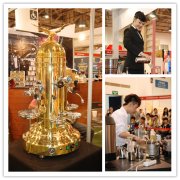
Bezerra Century Golden Eagle Coffee Machine High-end Limited Edition products
On the left is the Bezerra century-old golden eagle coffee machine known as Rolls-Royce in the coffee machine, and the top right is the first payment for university students to perform and mix drinks. The lower right holds a live coffee-making competition for baristas. (Wen / Luo Weiwei and Chen Xiaohong) Cake plus coffee is the perfect match for afternoon tea. Where there is cake, how can it be accompanied without coffee? Coffee is also a major protagonist in this baking exhibition. Except

The story of coffee
Professional coffee knowledge exchange more coffee bean information please pay attention to the coffee workshop (Wechat official account cafe_style) the exact origin of coffee is impossible to verify, you can peep into the mystery of the origin from many legends. 1. "in the sixth century, Kaidi, a shepherd in Ethiopia, one day found his sheep eating a red fruit.

The emergence of coffee demand in Europe began with the history and culture of coffee in the 17th century.
In the 17th century, there was a demand for coffee in Europe and began to import small quantities of roasted coffee beans from Yemen. In the 18th century, with the fragrance of European cafes and the sharp increase in coffee bean consumption, the Yemeni mocha alone was no longer enough. It is estimated that the output of coffee beans in Yemen in 2007 ○○ is about 20, 000 tons, which is stretched to meet the rising demand of Europe. The price of beans is high and the port of Mocha is busy.
How did coffee enter the Chinese market?
Coffee is said to have begun in the early 11 th century and can be found in ancient Arabic documents. Before that, coffee beans in the Arab region were dried and boiled as stomach medicine, and later learned that coffee also had a refreshing effect, coupled with the strict prohibition of alcohol by Muslim precepts. Muslims use roasted juice instead of alcohol as an exciting drink. It is said that the local people know how to use

How did coffee enter the Chinese market?
Coffee is said to have begun in the early 11 th century and can be found in ancient Arabic documents. Before that, coffee beans in the Arab region were dried and boiled as stomach medicine, and later learned that coffee also had a refreshing effect, coupled with the strict prohibition of alcohol by Muslim precepts. Muslims use roasted juice instead of alcohol as an exciting drink. It is said that the local people know how to use

Demand for coffee in Europe began in the 17th century with charcoal coffee stoves
In the 17th century, demand for coffee emerged in Europe, and small quantities of roasted coffee beans began to be imported to Yemen. In the 18th century, coffee shops were everywhere in Europe, coffee consumption soared, and Yemeni mocha alone was no longer enough. It is estimated that Yemen's coffee bean production in 1970 was about 20,000 tons, which is already insufficient to meet the newly emerging European demand. Bean prices remain high,

The emergence of coffee demand in Europe began in the 17th century
In the 17th century, there was a demand for coffee in Europe and began to import small quantities of roasted coffee beans from Yemen. In the 18th century, with the fragrance of European cafes and the sharp increase in coffee bean consumption, the Yemeni mocha alone was no longer enough. It is estimated that the output of coffee beans in Yemen in 2007 ○○ is about 20, 000 tons, which is stretched to meet the rising demand of Europe. The price of beans is high and the port of Mocha is busy.
Coffee history and culture have been controversial and have been considered important factors affecting children's learning.
Now we all know coffee is a good thing, but people used to think differently. Let's look back at centuries of endless debate over coffee. 16th century: Coffee can make people excited Legend has it that a shepherd named Kaldi in Ethiopia discovered that his sheep suddenly became excited after eating an oily green leaf and red berries. He tasted it himself.
Turkish coffee shops promote the British democratic revolution
The medieval theory of divine kingship began to crumble in England in the seventeenth century, and after the Glorious Revolution the basis of government had shifted from kings as God's agents on earth to the hands of people bound together by social contracts. After experiencing this great historical turning point, it can be said that the creed of modern democratic society, that is, the will of heaven, was formed. Ren Min Tong

The cooking method of Turkish coffee has not changed since the 16th century.
The method of cooking Turkish coffee has not changed since the 16th century, and it has always been made in a copper pot with a long handle. Ingredients: 1 Epico pot, 2 teaspoons coffee powder, 1 teaspoon water 70cc, 1 teaspoon sugar: 1. Add coffee powder and sugar to the pot and add water to 8 minutes full. 1. Take the kettle to the stove or small induction cooker and cook it. 3. Bring to the boil

The cooking method of Turkish coffee has not changed since the 16th century.
The method of cooking Turkish coffee has not changed since the 16th century, and it has always been made in a copper pot with a long handle. Ingredients: 1 Epico pot, 2 teaspoons coffee powder, 1 teaspoon water 70cc, 1 teaspoon sugar: 1. Add coffee powder and sugar to the pot and add water to 8 minutes full. 1. Take the kettle to the stove or small induction cooker and cook it. 3. Bring to the boil
Coffee Culture in Europe
Coffee formed a tradition in Europe after the development of coffee roasting technology in the Middle East at the end of the 14 th century. It was introduced through an exchange between the Ottoman Turkish Empire and the merchants of Venice, a Mediterranean trader. Coffee flourished in the 18 th century. Islamists call coffee a divine medicine given by Allah. So coffee is called coffee or cavha, which means it can bring energy to people.

Coffee culture the emergence of coffee demand in Europe began in the 17th century.
In the 17th century, there was a demand for coffee in Europe and began to import small quantities of roasted coffee beans from Yemen. In the 18th century, with the fragrance of European cafes and the sharp increase in coffee bean consumption, the Yemeni mocha alone was no longer enough. It is estimated that the output of coffee beans in Yemen in 2007 ○○ is about 20, 000 tons, which is stretched to meet the rising demand of Europe. The price of beans is high and the port of Mocha is busy.

Coffee culture the emergence of coffee demand in Europe began in the 17th century.
In the 17th century, there was a demand for coffee in Europe and began to import small quantities of roasted coffee beans from Yemen. In the 18th century, with the fragrance of European cafes and the sharp increase in coffee bean consumption, the Yemeni mocha alone was no longer enough. It is estimated that the output of coffee beans in Yemen in 2007 ○○ is about 20, 000 tons, which is stretched to meet the rising demand of Europe. The price of beans is high and the port of Mocha is busy.

The increase in coffee production caused the price to plummet.
With huge production capacity in Java, Sumatra, Sri Lanka and Suriname, the Netherlands became a global coffee trading center in the 18th century, and prices fell from ridiculously expensive at the beginning of the 18th century to affordable for ordinary people after the middle of the 18th century. As the great powers exploited hundreds of thousands of African slaves to grow coffee in the colonies, the price is far more competitive and the production capacity is higher than that of the Yemeni mocha.

Common sense of coffee roaster used in coffee shop
Coffee shop bean dryers, retail bean dryers, and small bean dryers are all medium to small bean dryers, which are often used in coffee shops during wartime. Before the early 20th century, most of their coffee beans were made by bean roasters in such cafes, as long as they were not baked at home, but by the early 1950s, large baking plants and pre-ground